Five Financial Habits of Successful Families

Updated: Aug 27
“Wealth is not only what you leave for your children. It is what you teach them to build.”
Opening Story
Imagine two families.
Both parents work hard.
Both earn a reasonable income.
Both want the best for their children.
But their financial habits are very different.
Family A spends first and saves whatever is left.
Family B saves first, plans their spending, builds assets and regularly reviews their financial goals.
Family A talks about money mainly when there is a problem.
Family B talks about money as part of everyday life.
Family A teaches their children how to spend.
Family B teaches their children how to manage, save and own.
Twenty years later, the difference may be much bigger than the amount of money each family earned.
Because children don’t only inherit money.
They inherit financial habits.
That is why building wealth isn’t only about your bank balance.
It’s also about building a family culture around money.
Today’s Lesson
Financially strong families don’t necessarily have perfect finances.
They still have unexpected expenses.
They still make mistakes.
They still have months when spending is higher than expected.
The difference is that they develop systems and habits that help them recover and continue moving forward.
Here are five habits that can make a significant difference.
✴️ Habit #1: They Save Before They Spend
Successful families understand that saving shouldn’t depend entirely on whatever is left at the end of the month.
Because very often:
There is nothing left.
Instead, they decide in advance how much money should be allocated towards savings and financial goals.
The amount doesn’t have to be huge.
What matters is consistency.
Income → Save → Allocate → Spend
rather than:
Income → Spend → Spend → Spend → “Hopefully there’s something left.”
✴️ Habit #2: They Build an Emergency Fund
Financially responsible families understand that emergencies are part of life.
They prepare for unexpected expenses instead of assuming everything will always go according to plan.
An emergency fund provides a layer of financial protection when something unexpected happens.
And importantly, emergency savings should be distinguished from long-term investments and assets.
Your emergency fund needs to be accessible when you need it.
Once your basic financial foundation is established, you can then consider building longer-term assets according to your financial goals.
✴️ Habit #3: They Buy Assets, Not Just Things
There’s nothing wrong with buying things that make life enjoyable.
But financially strong families don’t allow consumption to become the only destination for their income.
They also think:
“What can I own?”
Instead of spending every extra ringgit on lifestyle upgrades, they allocate part of their resources towards building assets.
This could include investments, property, business interests or physical gold—depending on their financial objectives and circumstances.
The goal isn’t to stop spending.
It’s to create a balance between enjoying today and preparing for tomorrow.
✴️ Habit #4: They Teach Their Children About Money
Financial education shouldn’t begin when children become adults.
It can start with simple conversations.
Teach them:
✅ Saving.
✅ Budgeting.
✅ Delayed gratification.
✅ Needs versus wants.
✅ The difference between spending and owning.
You can even give children simple financial goals.
For example:
“If you want this toy, let’s work out how much you need to save.”
Now the child learns something powerful.
They learn that money is not unlimited.
They learn that goals require patience.
They learn that waiting can be rewarding.
Those lessons may stay with them much longer than any financial lecture.
✴️ Habit #5: They Think in Generations
The strongest financial mindset isn’t:
“How can I spend my money?”
It is:
“What am I building?”
This changes the conversation.
Instead of thinking only about this year’s income, you start thinking about the next 10, 20 or 30 years.
What assets can I build?
What financial knowledge can I pass to my children?
❓How can I reduce unnecessary financial burdens?
❓How can I create greater financial resilience?
❓How can I leave something meaningful behind?
That is the beginning of a legacy mindset.
Gold Mentoring Insight
Gold can become an interesting part of this conversation because it allows families to combine asset ownership with financial education.
Public Gold currently offers various physical gold formats, including gold bars and dinars. The product sizes listed by Public Gold include gold bars from 5g, 10g, 20g, 50g, 100g, 250g and 1,000g, while its dinar options include 1 Dinar (4.25g), 5 Dinar (21.25g) and 10 Dinar (42.5g).
Different sizes can serve different accumulation objectives.

Gold Bars
💡 5g
A smaller physical bar that can be considered by someone beginning to accumulate physical gold.
💡10g
A practical size for someone who wants to build physical holdings gradually.
💡20g
Suitable for someone looking to accumulate larger quantities over time.
💡50g
A larger denomination for those with a bigger allocation towards physical gold.
💡100g
A substantial physical holding that may form part of a long-term asset strategy.
💡250g
A larger bullion size generally more suitable for significant physical accumulation.
💡1,000g
A 1kg gold bar represents a substantial physical holding and is clearly a very different scale of accumulation from smaller denominations

Dinar
Public Gold also lists:
💡1 Dinar = 4.25g
💡5 Dinar = 21.25g
💡10 Dinar = 42.5g
The important lesson isn’t that every family needs to own every size.
They don’t.
The appropriate product depends on the individual’s financial capacity, objective, liquidity needs and overall asset allocation.
The real lesson is that gold can become a practical way to teach a family the concept of owning assets instead of simply consuming income.
Imagine a parent telling their child:
“This gold isn’t something we bought because it was trendy. We bought it because we’re building an asset for the future.”
That’s a very different financial conversation.
Turn Gold Into a Financial Lesson
Imagine a parent gradually accumulating physical gold.
One year, they acquire a 5g bar.
Later, they add another.
Eventually, they may progress towards larger denominations as their financial capacity allows.
The child watches the process.
They see that money can be converted into something tangible.
They learn that wealth doesn’t necessarily appear overnight.
They learn that assets can be accumulated gradually.
And most importantly, they learn:
“We don’t have to spend everything we earn.”
That lesson can be more valuable than the gold itself.
Because one day, the gold may be sold.
But the financial habit can remain for life.
Practical Action
Today, start your Family Wealth Habits Checklist.
Sit down with your spouse or family and discuss these five questions:
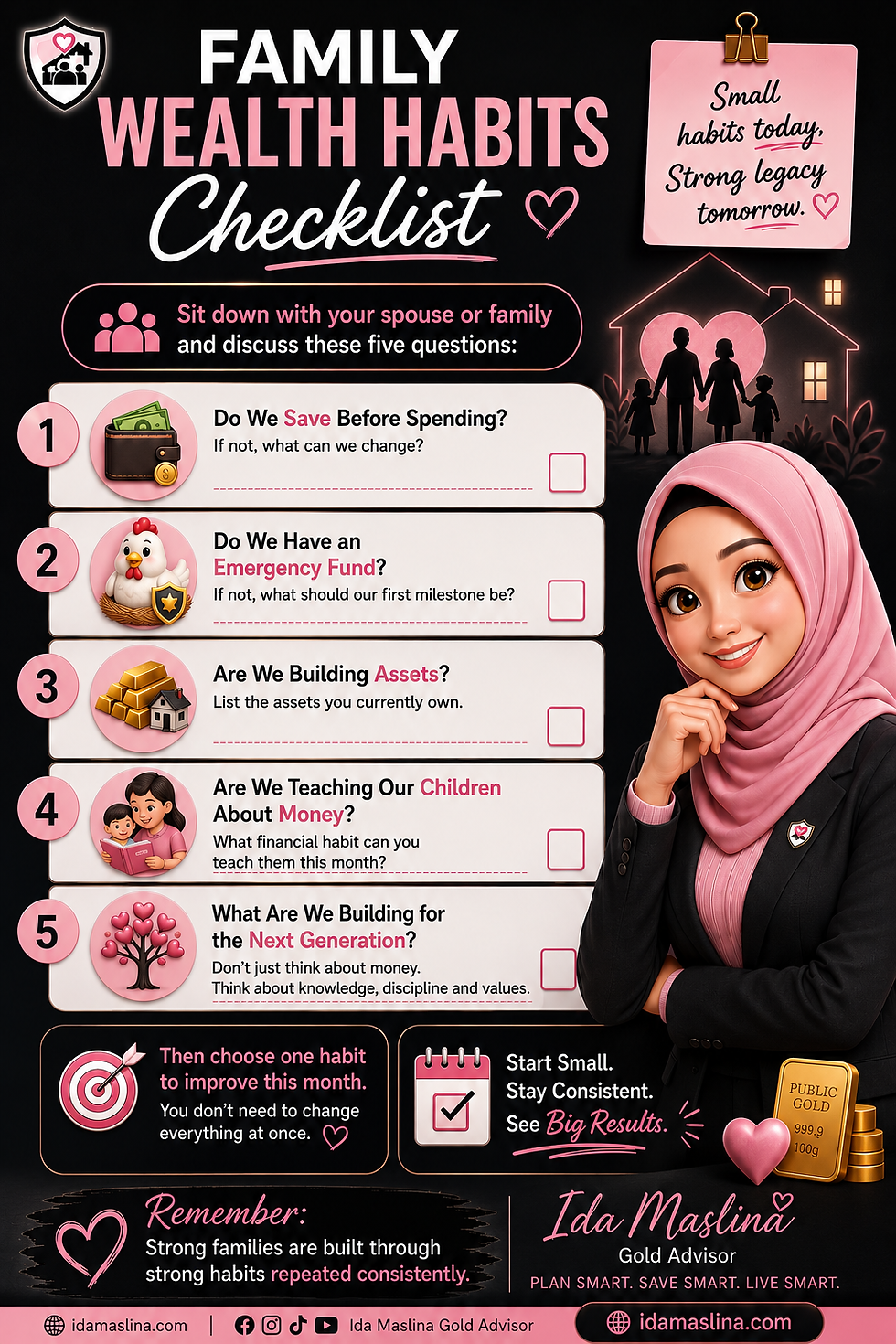
1. Do We Save Before Spending?
If not, what can we change?
2. Do We Have an Emergency Fund?
If not, what should our first milestone be?
3. Are We Building Assets?
List the assets you currently own.
4. Are We Teaching Our Children About Money?
What financial habit can you teach them this month?
5. What Are We Building for the Next Generation?
Don’t just think about money.
Think about knowledge, discipline and values.
Then choose one habit to improve this month.
You don’t need to change everything at once.
Remember:
Strong families are built through strong habits repeated consistently.
Motivation of the Day
“Don’t just leave your children an inheritance. Leave them the knowledge and discipline to build their own.”
Final Thoughts
A financial legacy doesn’t begin when you die.
⚡️It begins while you’re alive.
⚡️It begins when your children watch you save instead of spend everything.
⚡️It begins when they see you plan before making financial decisions.
⚡️It begins when you explain why you are building assets.
⚡️It begins when you teach them that money is a tool—not a status symbol.
⚡️And it begins when you demonstrate that wealth isn’t about looking rich.
It’s about becoming financially stronger.
Gold can be part of that journey.
👉A physical gold bar.
👉A dinar.
👉A savings account.
👉An investment portfolio.
👉A business.
Different families will choose different assets.
The important thing is understanding why you own them and what role they play in your financial plan.
Because ultimately, your greatest legacy may not be the amount of gold you leave behind.
It may be the mindset you leave behind.
Start Your Gold Journey
If you want to start building a family culture around saving and asset ownership, Gold Mentoring can help you understand the journey step by step.
Whether you’re interested in starting with smaller physical gold such as a 5g bar or 1 Dinar, or eventually building towards larger denominations such as 50g, 100g, 250g or 1kg bars, the right starting point should always be based on your financial capacity and objectives.
I also started with only 1g 8 years ago and from there I gradually bought 10g, 20g, 50g, 100g and the largest is 250g. Do I stop after that? No, I'm still accumulating till today.
Why? You have to start the Gold Mentoring with me, then I'll tell.
Public Gold also offers 5, 10 and 20 Dinar options, corresponding to 21.25g and 42.5g for the 5 and 10 Dinar sizes respectively.
You don’t need to buy the biggest bar.
You don’t need to accumulate everything at once.
And you certainly don’t need to compromise your emergency fund or essential financial commitments just to own gold.
⚠️Start appropriately.
⚠️Build consistently.
⚠️Teach intentionally.
⚠️Think generationally.
Because true wealth isn’t simply about how much you accumulate.
It’s about what your family learns while you’re building it.
And that may be the most valuable asset you ever leave behind.
Ida Maslina
Gold Advisor, Public Gold


Comments